Are ruminants really destroying our planet?

Ruminants are known as the biggest contributors to global warming. Their production of methane is more harmful for our planet than CO2. On top of their own production of greenhouse gasses, their transport requires fossil fuels and therefore emit CO2. Besides, keeping cattle requires enormous amounts of water. Therefore, we should all stop eating meat. Problem solved. 

Last week one of my peers of the Scientific English course I take, gave a presentation about cows and global warming. A vet student, just like me. Obviously, it was not the first time I heard something about the role of cattle in the light of global warming but still, this topic triggered me. Most probably because of a TED -talk by Allan Savory I came across recently. He claims that the solution for global warming can be found in the increase of livestock, rather than a decrease. 

Allan Savory, is a 83 years old Zimbabwean ecologist and live- stock farmer. In his TED talk Savory puts forward a new theory concerning the reverse of desertification. Desertification is a term used to describe the phenomenon of lands turning into desert. He argues that technology is not going to solve any problems, though, livestock will. The answer will be in rotational grazing, a strategy used before we started with intensive agriculture. Big herds of livestock are kept on a certain piece of ground for a short amount of time. Livestock eats and excretes and before the ground is exhausted, the herd leaves. Therefore the damage of the ground will be minimal and it has time to recover. Savory also explains how this strategy of farming can decrease the emission of greenhouse gasses but because of my lack of expertise in this field, I would recommend you to watch his video yourself.

To be honest, I’m a laic when it comes to ecology and I did not do my own research in this field. Savory caught me with his idea about the huge numbers of livestock that have always been living on the African grounds. Like Savory, I would’t deny global warming. I truly believe there is a problem caused by human kind what needs to be solved. I also think there is is a lot wrong with the way we produce meat nowadays and how we manage livestock. However, rather than blaming cattle for all the damage, I think it is worth considering to leave technology and intensive agriculture and return to a system of rotational grazing. 

SWINGING A LAMB ALIVE

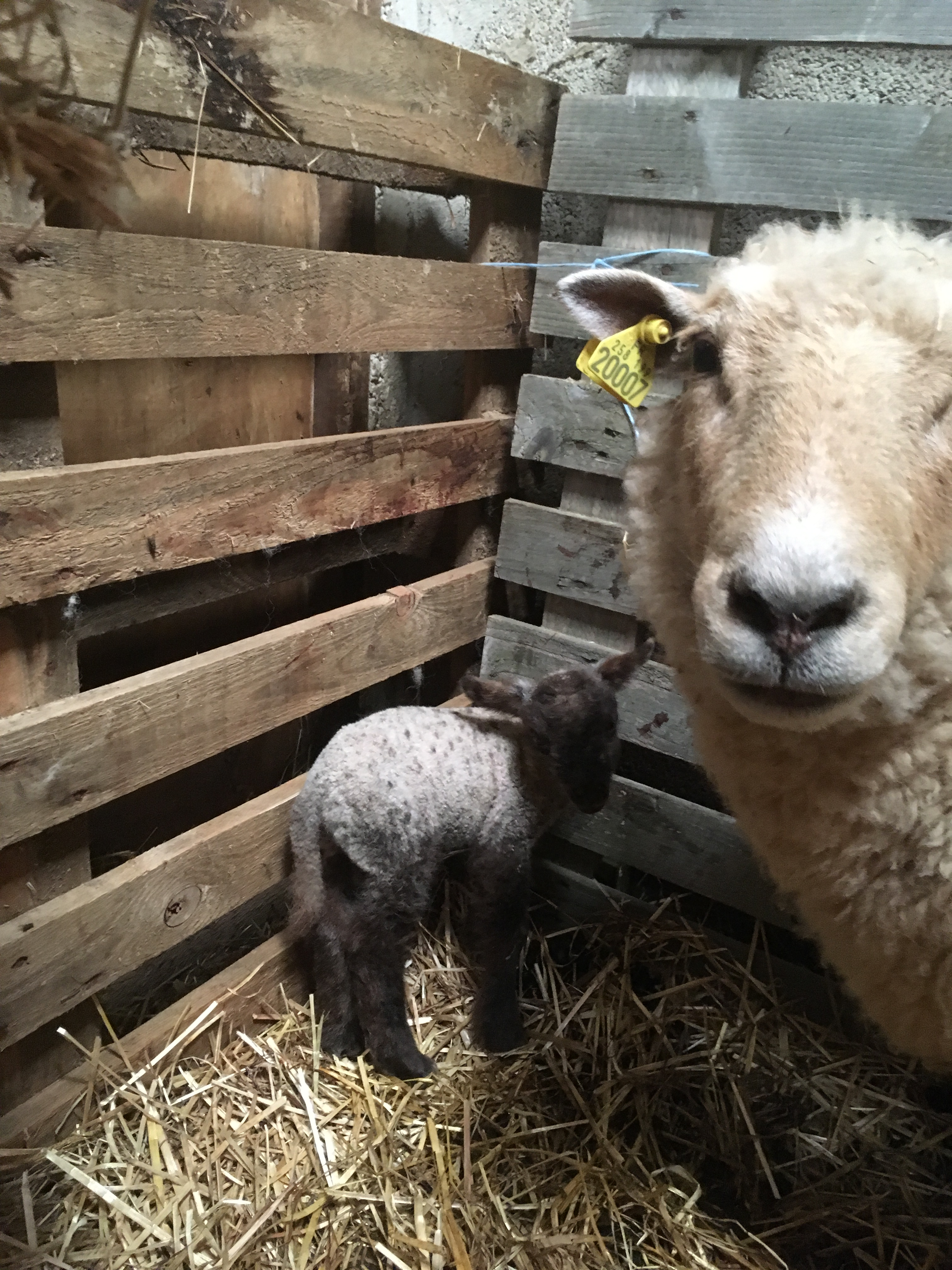
Lambing season is intens. A blend of farm labour, miracles of mother nature and emergency medecine. I consider it to be a valuable experience for every future veterinarian. Recently I spent two weeks on a farm in Brittany, France. 

Approximately 90 would give birth this season. I learned a lot from Lisa, the farmer I stayed with. Mostly practical skills, that I doubt I would learn in vetschool.

One evening we received a call from a farmer nearby. One of her ewes experienced difficulties giving birth and she has been in labour for quit a while. After our arrival, with a little help, the ewe could deliver her lamb. However, the newborn was not out of the woods yet: it was suffocating. After a lamb is born, you always clean the nose and mouth from present mucus. However, after the cleaning, the lamb did not start to breath. It was wheezing instead. We thought it might have fluids in his airways. Neither me or Lisa had ever been in this situation before. We decided to swing the lamb. This means you hold the lamb upside down and you swing it. You hold it on its legs and offer support on the chest to make sure you won’t dislocate the hips. The philosophy behind this, as Lisa told me, is to clear the airways by using gravity. Surprisingly, after a while and a few long swings, the lamb’s breathing improved. 

This event triggered my interest. I was curious to find out what could possibly the mechanisme behind this technique. If it really is gravity or if there is another theory. As well was I curious what might have caused his airway troubles. This case would make a great subject for my scientific blog, I thought. Once I was back in Belgium I started searching literature. To my surprise, I could not find any cases like this. Instead, I found models for resuscitation in human newborns, oxygen problems in fetal lambs the most common obstetrical complications in ewes had been. Research on complications for lambs during or right after birth, appears to be scarce. 

Ofcourse we had been speculating about a possible cause of the airway problems. Maybe it was the length of the partus. Maybe he couldn’t excrete internal fluids out of his lungs. Maybe he swallowed fluids during labour. For now, I dont’ have any answers of my questions but maybe I’ll find the opportunity to investigate cases like this in the future. 

Influenza in Horses: Is Vaccination the Solution?

If your vet asked you to get a vaccin to protect your horse against the flu, it’s likely that you would. Especially when you could also protect all other horses in your area. However, I wonder if it’s as easy as it seems. I’m from a small village in the Dutch countryside. My area is a paradise for equestrian- lovers. Last December there was a flu outbreak in several sportstables. In order to fight this outbreak, a local equine clinic urged horse- owners to come for a booster vaccination as soon as possible. 

Like in people, the flu in horses is caused by a type of influenza virus. Infected horses suffer from severe airway problems and typically high fevers. The infection is self limiting so after some rest the horse will recover by itself. In absence of a secondary infection, like a bacterial one, the flu is rarely fatal. Which brings me to my first concern. A vaccination causes an immune response in the body and it starts producing antibodies against the flu. This is exactly what you want. However, with the vaccine several other foreign bodies come in. While the body is busy fighting these, won’t it be more vulnerable for a bacterial infection? 

Vets consider vaccination as an acceptable prevention for the flu. You should get your vaccination every 6 months to keep an adequate immune status. However, just like the flu in people, the virus circulating among horses changes rapidly. This makes the development of a proper vaccin difficult. So, even if your horse has its vaccinations, it can get the flu.  Moreover, it takes 2- 14 days after vaccination to gain a sufficient immunity status. In other words, your horse can still get infected by influenza in those days. So, you challenge your horse’s immune system and it’s still vulnerable of influenza.

Vaccination is a complicated topic and the immune system is complex. I’m convinced that the booster- campaign was started with the best intention but I wonder whether it is the best option. The World Organisation for Animal Health recommends a movement restriction to fight an influenza outbreak. The flu spreads easily through the air, via other horses, people or equipment. Taking your horse to a vet, would mean a higher risk to come in contact with the virus.I would favor to give our horses some rest if they get the flu, instead of giving them injections two times a year while there’s still the risk of getting ill.

Ontwerp een vergelijkbare site met WordPress.com
Aan de slag